
David Brackin, contributing editor to ChannelX and founder of StuffUSell speak to Royal Mail at eBay Open 2026:
Royal Mail was hard to miss at eBay Open. There were dozens of them in bright red T-shirts, so when a Royal Mail problem came up in my eBay seller clinic it seemed a good opportunity to get everyone in the same room and sort it out.
One of the eBay accounts I help manage was at risk of losing Top Rated status because of late deliveries. It was a handful of parcels, all in the same week in August. That is enough. eBay’s published standard for Top Rated is a late delivery rate of no more than 3% of transactions, measured over the past three months for any account with more than 400 transactions in that period. Nobody loses Top Rated on the first late parcel. You lose it on the last few. An account doing 2,000 orders a quarter has 60 late deliveries to play with, and a single York cage left unscanned might be enough to put you over the line.
When the customer service team in Dublin went through the cases with me, we found that we had not sent them late. We had handed the parcels to Royal Mail on time. Royal Mail had not scanned them.
From eBay’s point of view that amounts to the same thing. eBay’s definition of a late delivery has two parts. The delivery scan is after the latest estimated delivery date, and there is no carrier scan within the seller’s dispatch time. If there is no acceptance scan showing that the parcel entered the network on time, eBay has no evidence that it did. The Dublin team were sympathetic, but there was nothing they could do.
So I went to talk to eBay’s policy team. They knew about the problem. Royal Mail can be slow with its initial scans, they explained, and eBay has built a buffer into its late delivery measurement to allow for it. That sounds reasonable, but it does not solve the problem, and nobody could tell me how many days the buffer is.
The difficulty is the way Royal Mail is measured. Its service targets count how many parcels are late, not how late they are. That creates an odd incentive when a depot gets behind.
Suppose a batch of Monday’s parcels is not processed on Monday. By Tuesday they are already late, whereas Tuesday’s parcels can still go out on time. So it makes sense to deal with Tuesday’s post first. The same thing happens on Wednesday. Monday’s parcels can end up being scanned on Thursday. From Royal Mail’s point of view one bad day has not turned into three. From eBay’s point of view your Monday parcel was dispatched on Thursday, and you get the defect.
Was August the month a depot was short of staff over the holidays? I do not know, and that is part of the problem. When we spoke to our 3PL they said they were seeing the same thing with other clients, including sellers on Amazon and other marketplaces.
That makes it a bigger issue than one account. Marketplaces increasingly use carrier tracking data to decide whether sellers are doing a good job, which makes the carrier’s first scan part of your marketplace performance. If Royal Mail gets it wrong, it is the seller who loses Top Rated status, not Royal Mail.
With eBay, Royal Mail and several hundred sellers under the same roof, I went over to the Royal Mail stand to see if we could talk about it.
Apparently not. They were very sorry but could not discuss it with me there. I was asked to scan a QR code and fill in a form, and someone would get back to me.
This is how these problems usually go. Customer services pointed me to the policy team. The policy team pointed me to Royal Mail. Royal Mail pointed me to a QR code. I was lucky to have all of them in the same building on the same day, and it still did not get resolved. Each person I spoke to was helpful and each was certain that the fix sat with somebody else.
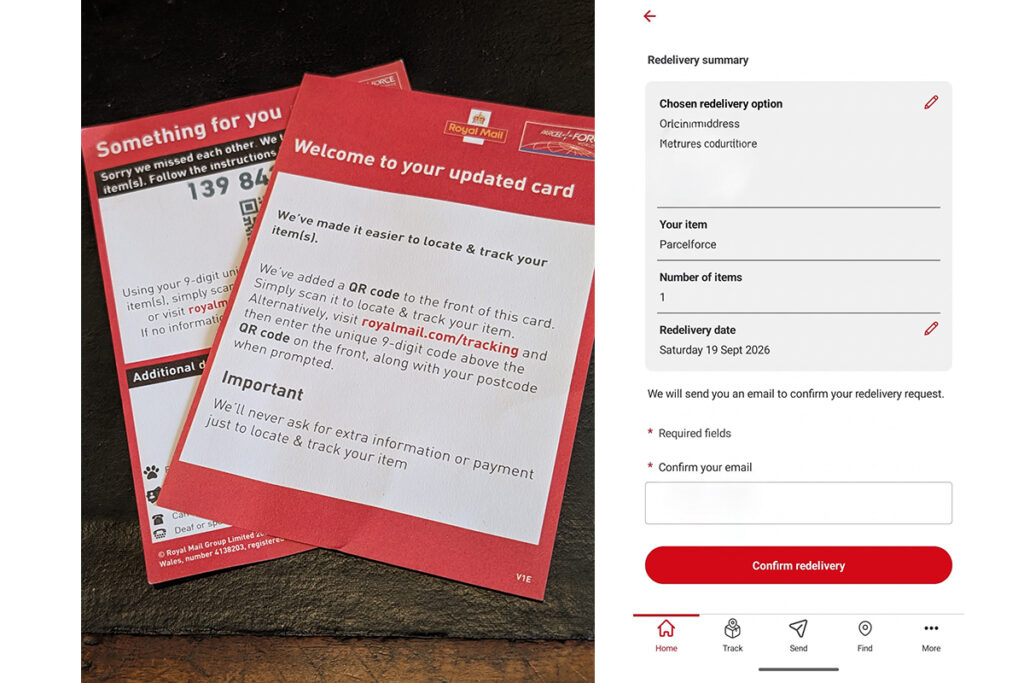
Then I got home. Royal Mail had tried to deliver a parcel while I was away and left one of its new “Sorry we missed you” cards. The card pointed me to a QR code. The QR code pointed me to the website. The website pointed me to a page that did not work, where I could not enter the information it wanted and was left with a button that would not press. The page pointed me to a telephone number. I rang it, worked through the automated options and chose help with redelivery. The recorded message pointed me back to the website.
Then it hung up. There is something almost impressive about closing the loop quite so completely. The chain at eBay Open had at least ended with a human being promising to get back to me. The one at home ended with a dial tone.
None of this means Royal Mail is a bad carrier. It handles an enormous number of parcels and we have used it for years.
But a marketplace seller needs more than a carrier that usually gets the parcel there. The scan has to happen and the tracking has to be right, because that data is now used to judge us. When it is wrong, the marketplace says it cannot help because the carrier data shows the parcel was late, and the carrier’s systems offer no obvious way to correct the record. The seller carries the consequences of somebody else’s operational failure.
There is a wider question for eBay too. Seller standards are supposed to measure how well sellers perform. If a seller hands a parcel to one of eBay’s recognised carriers on time and the carrier fails to scan it, should that count as evidence that the seller dispatched it late? I have written before about Goodhart’s Law. Once a measure becomes a target, people optimise around the measure, and a metric is only useful if it measures the thing you think it measures. Royal Mail’s late-parcel target is a fine example. It rewards clearing today’s post ahead of yesterday’s, and the cost lands in eBay’s seller standards.
Royal Mail will have bad days. Parcels will be missed and scans will fail. The question is what happens afterwards. Can Royal Mail identify parcels that missed their first scan? Can it correct the record? Can a business seller reach somebody who understands why it matters? Can Royal Mail and the marketplaces agree a way for carrier failures not to be recorded as seller failures?
For marketplace sellers these are not customer service niceties. Account status depends on them, and it is always the last handful of parcels that tip you over the line.
Royal Mail had plenty of people at eBay Open telling sellers about its services. What I could not find was anyone able to deal with the consequences when the service goes wrong. If your marketplace account depends on Royal Mail getting the data right, how much of your business are you prepared to trust to it?







5 Responses
I don’t think Rm will ever change it’s ways. It’s done well by bringing things in to the 21st century like click and drop, and if you compare to the original DMO (I think it was called), it’s amazing.
But when you want things solved, it’s a whole different ball game.
An example is a claim for a lost item.
You go to the section on the website and scroll to find the correct button for claims, then through a multitude of data entries like YOUR TITLE, name and address are NOT necessary but mandatory as the tracking number will be able to identify that information. Lots of other data to enter and finally proof of cost price IE Invoice.
BUT, the fun doesn’t stop there.
Once you get the acknowledgement, there’s a reference. Great BUT it’s a “do not reply” from email address AND there’s nothing in the email acknowledgement about what the claim is for. So if you have an international claim, what I have to do is forward the acknowledgement to myself with the actual tracking link and then snooze for two months. If I get a response within that time then it will usually just show the reference and from there I can search to find the tracking number and then look in to what it was about.
If there was an email thread from the start it would be so much easier, but, I FEAR, it’s all by design to make it as difficult and complex as possible so people will give up or not bother in the first place.
Luckily, some of us work out ways to make it slightly less painful!
There are workarounds to most things, but finding them takes precious time.
I found a way to deal with our £100,000 per year Royal mail account. I dropped them and moved everything to FBA.
Royal Mail need to fix the lie that Tracked 24/48 are scanned “end to end” as their marketing fluff puts it.
The issue that is causing eBay failures is that the parcels in a sack of mail are not individually scanned when they are collected. Nor are they scanned at the local sorting office when the saacks are emptied or put in Yorks to go to the Mail Centre. They are not scanned in at the Mail Centre, the Yorks go into a pending situation (and our local Jubilee Mail Centre is famous for it’s backlogs at this point), and the first scan only finally happens when the Yorks are emptied onto the conveyor belts. That can be up to a week later if there’s a backlog. It’s certainly not “end to end” tracking.
But I also wish eBay were far more realistic with the delivery expectations they give the buyers. My data shows Evri and Royal Mail are about as reliable as each other, the only difference is that when something goes wrong at Evri their bot is actually quite good at solving problems if you know how to talk to it.
For larger sellers that have mail collected – When the postie arrives to collect the mail instruct them to do an acceptance scan on their handset – On the handset they need to click Indoor – then Enquiry office – then Acceptance scan – Then scan every item (it does not take long – we have over 100 packages some days) You now have the frst scan required. We have doing this for a few years now and it works and you will have zero late parcels.
Lee Graves
I don’t see them changing how they work, so the backlogs of unprocessed parcels in unopened mail sacks will continue. But if they would change the tracking system for those of us with click and drop business accounts, daily collections, it would deal with a lot of our customer service problems.
All that needs be done, is for the manifest scan to be treated as the first scan, to show a parcel is in their possession and on the way. Assume the manifest is true and correct, that the parcel is in one of the sacks. Because it is! The number of times a sender would lie about posting an item, must be insignificant in comparison to the number of times a parcel is spending days sitting unprocessed at a mail centre.